Pride of the Aristocracy, Soul of the Samurai – Collections including swords of Regents and Shoguns.
Till March 31st at Kasugataisha Museum
A superb exhibition of swords at Kasugataisha Museum comes to a close at the end of this month. Japan can always be relied upon to throw a good show, large or small, since its repositories of premodern art and historical artifacts are often ones – temples and shrines – that are full of exceptionally high quality offerings to the gods, or objects that were created as icons. They therefore demand treatment as actively sacred objects that (arguably) require expenditure of greater preservation efforts than those deemed absent of holy alliance or meaning do. Whether preservation is indeed superior or just different is a question worth exploring – though this isn’t the place to do that. But admirers of sword manufacture, swordsmanship, decorative art, as well as historically situated ideologies of warfare, and those interested in how weapons crossover into the worlds of highly refined dance costume and choreography and of social status signified by apparel, will find rich pickings at Kasugataisha’s exhibition.

As is often the case with museum and art exhibitions in Japan, English (not to mention other foreign languages) information is rather scarce, but that should not dissuade the enthusiast or the curious. To a certain extent the pieces on display speak for themselves. They range in age – the exhibits date from the 12th to the 19th century – and in type, long and short, shakudozukuri and hyogogusari types, and some small koshigatana hip-swords. The smiths and donors of several are attested – the former are mainly of Echizen and Bizen provinces, both famed for their swordsmiths, and the latter include the Fujiwara regency and Ashikaga shogunal clans. Materials used in the hilts and scabbards are of a rich variety: black and red lacquer is common, but brocade is sometimes used, as is mother of pearl inlay, along with rock crystal and semi-precious stones, stingray rayskin (called “sharkskin”), and silverplate.
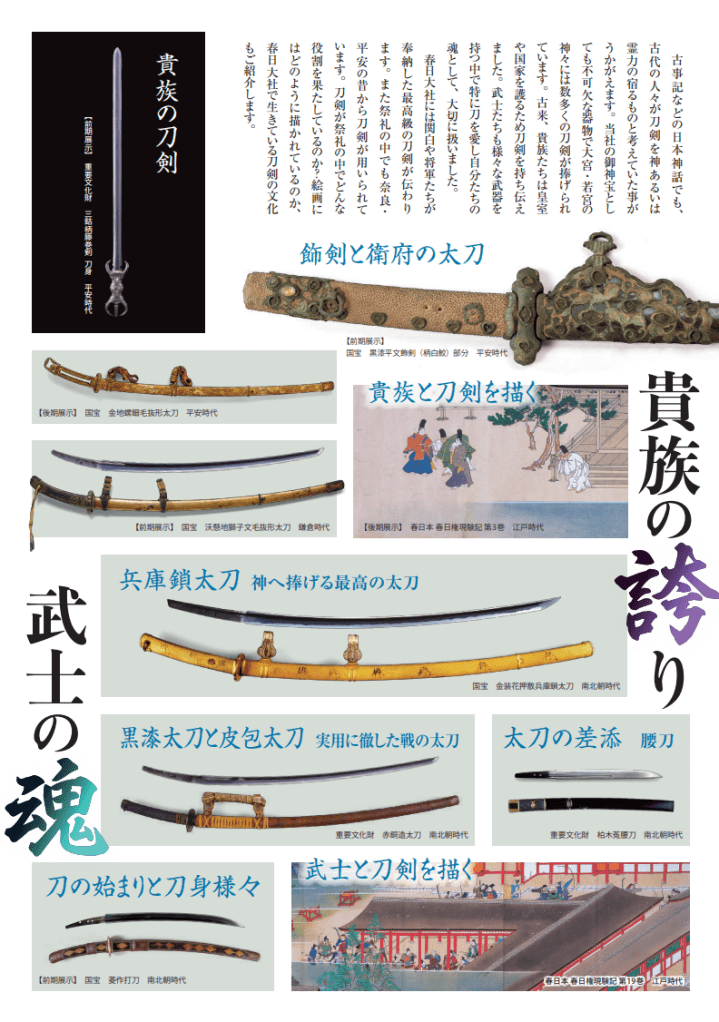
Though the swords on display are largely ones offered to the deities of the shrine, viewers might be reminded of not only how rare the possession and acquisition of skill in handling swords were but also how meaningful possession and skill were. Swords were generally considered not merely objects, but inhabited by souls or spirits, and so they possessed an identity for their owner that went beyond that associated with function as weapon, personal belonging, or symbol of status/authority. They were additionally embedded in a much wider culture of meaning: particular battles (and a history, cultural memory and ideology of battles) and warcraft; a now extinct hierarchy of power; a world of other objects imbued with spirits; and a world in which the body of a fighter operated in distinct ways. Brutal though he may have been in practice (as illustrated by some gory scenes in the 18th century Kasuga Gongen Genkie picture scroll) the sword-wielding warrior moved according to a certain choreography. The phenomenon of subsuming violence and killing into an elegant, luxurious part of a nobleman’s apparel (and, in the 17th and 18th centuries, its non-functional inclusion in the wear of the non-fighting samurai class) is also something to keep in mind. In part, this subsumption reflects societal attitudes toward fighting and battleground death – swordsmanship has cross-culturally often been an art as much as a method of destruction – something nicely encapsulated in the title of the exhibition. The same collusion of meaning and function smoothed into dignified art is found in traditional dance: a lot of fighting moves and scenes are used in courtly Bugaku.
A sword that is part of a Bugaku costume for the “Taiheiraku” dance and dated to between the 17th and 19th centuries is on show. It has an attractive white sharkskin hilt, inlaid rock crystal, and some exquisite bronze metalwork of curling vines leave and flowers. The shark (ray) skin, that appears like a sheath of multiple tiny white beads, was imported from the India, Thailand or Indonesia, and was both a luxury material but also quite durable and provided a good grip. Other pieces are similarly ornamental and had been forged and decorated specifically as offerings to the deity of the Kasuga Grand Shrine by patrons and members of the clan who worshipped this deity as their clan god.
In 1135, the Fujiwara regent Tadazane and his son Yorinaga offered a rosewood sword to a newly-introduced young Wakamiya deity. Its mother-of-pearl inlay and black lacquer motifs of birds, trees, and mountains over silver plate are a one of a kind technique called Kinban kurourushi densō. It is a uniquely beautiful work of art and craftsmanship. Yorinaga would have been 15 years old at the time. He died in the Hogen Insurrection just 21 years later, the battle that decisively ended Fujiwara dominance and marked the real start of the rise of samurai. The intensity of the often violent power struggles between factions throughout the feudal age is another background against which to understand these sword offerings – as symbols of power sought and requested from a higher power, in that power was as much a sign of plenty as the riches that adorned these swords were.
Please see the April 2024 exhibition listings for current and upcoming sword shows at The Museum, Archaeological Institute of Kashihara, Nara Prefecture, and Kashihara Shrine Treasure Museum.
 ART & RITUAL JAPAN