Kūkai: The Worlds of Mandalas and the Transcultural Origins of Esoteric Buddhism at Nara National Museum, Sat, Apr 13, 2024〜Sun, Jun 9, 2024 (Preview)
One of the exhibits in the upcoming Kūkai: The Worlds of Mandalas and the Transcultural Origins of Esoteric Buddhism that stands out for its novelty – and for what it suggests about the historical trajectory of esoteric Buddhism and its icons – is the 10th century seated bronze image of Mahāvairocana Buddha, a component of the “Sculptural Mandala of the Diamond World” excavated from the Mahapajit Temple Site in Nganjuk, Java. The broad geographical network that shaped esoteric Buddhism both before and after it was adopted in Japan included Indonesia, an area that is rarely acknowledged in exhibitions of esoteric Buddhist art here. Indeed, there are significant developments in the meaning and portrayal of Mahāvairocana the principle deity, and the wrathful deities that had entered Java before esoteric Buddhism had been fully adopted in Japan (known there as Mikkyo), so exposure to iconography there may be helpful in piecing together the story of Buddhism across the region (and how it contrasts doctrinally and iconographically from its counterparts in other cultures), and the equally compelling stories of the deities, their battles, and their places in the cosmos. Indeed this transculturalism is indicated by the title of the exhibition – and the promised exploration of it is one of the main attractions. Sculptural representations of the mandalas are relatively rare, and this one, though much smaller, might be compared with an early three-dimensional mandala in Tōji Temple, Kyoto, as well as with the much more common painted mandalas. A link between the Nganjuk mandala and the Diamond World mandala of the Shingon school of Japanese esoteric Buddhism has been suggested by Seno Joko Suyono here.
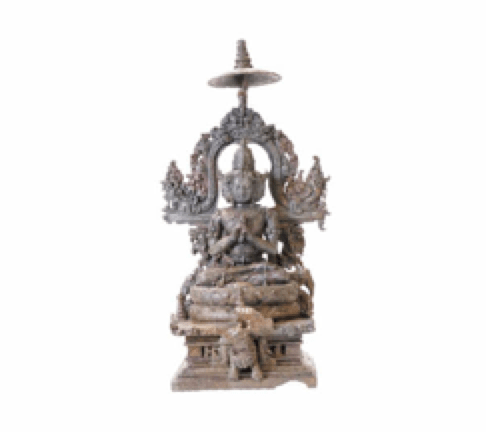
National Museum of Indonesia, Jakarta
Indonesia, 10th century
A second object of note is the Takao Mandala, which is being shown for the first time after a six-year conservation that began in 2016.

Takao Mandara: Diamond World
Jingōji Temple, Kyoto
Heian period, 9th century
The “Ruler of the Silent Dust”, the name bequeathed upon Siva in a transformation by a triumphant Vairocana, an episode that explains some of the imagery of the Nganjuk mandala and a notable one in the story of esoteric Buddhism as Hindu and Buddhist beliefs in India came into contact and conflict with each other, operates as a nice (if twee?) metaphorical image for the exhibition as a whole – though artifacts excavated are silent (and dusty) no more, and the Takao Mandala is likewise restored and renewed. As they move through cultures, deities’ names and their images transform through contact, conflict, resolution, absorption. The Nganjak Vairocana in conjunction with its Japanese counterpart, Dainichi Nyorai is a reminder of this: the mythical creatures surrounding his mount – the piscine makara, and the horned wyālaka lions – are Indian, and never made their way to the sparer depictions of this deity in Japanese esoteric Buddhism.
Nara National Museum’s show promises to be a superb one, in part because Japan’s collections of Mikkyo art are rich and well-preserved. But it also stands out among the steady stream of such shows in Japan that have been put on over the last few years (in approximate correspondence to the 1250th anniversary of the birth of the founder of this school of Buddhism in Japan, Kūkai (774-835)) because brand new exhibits are unusual, so the concept and content of this early-summer show is particularly welcome. Another piece on display, on loan from Beilin Museum, Xi’an merits mention here: an 8th century Wenshu (Skt. Mañjusri), excavated from the Anguosi Temple Site in Xi’an, which is a fine sculpture (and a Class One National Treasure in China). The curators of the Nara National Museum show speculate that this may have been seen by Kūkai while he was in that part of China, and – whether he viewed this particular statue or not – it offers extra context to the trans-Asian background and intermingling of Buddhist traditions that may or may not have influenced its iteration in Japan. (Another preoccupation found in scholarship is what, exactly, Kūkai was exposed to and possibly influenced by during his sojourn – in this vein, some wild theories have whirled around the so-called Nestorian Stone in Xi’an. Writer Shiba Ryotaro’s colourful vision of Xi’an at the time of Kūkai’s life there, which really was a metropolis populated and passed through by people of a wide array of ethnicities, occupations, and religions, is brought to life in his transporting (and sometimes imaginative) history, Kukai the Universal.) But differences – most obviously in styles – evidenced by this Wenshu statue can jolt the viewer out of an over-familiar and fossified view of Buddhist art, and Mikkyo, in Japan. It’s also fantastic as always to see museums of Buddhist art in Japan collaborating with museums in other parts of the Buddhist world – here, the National Museum of Indonesia and the Beilin Museum in China.
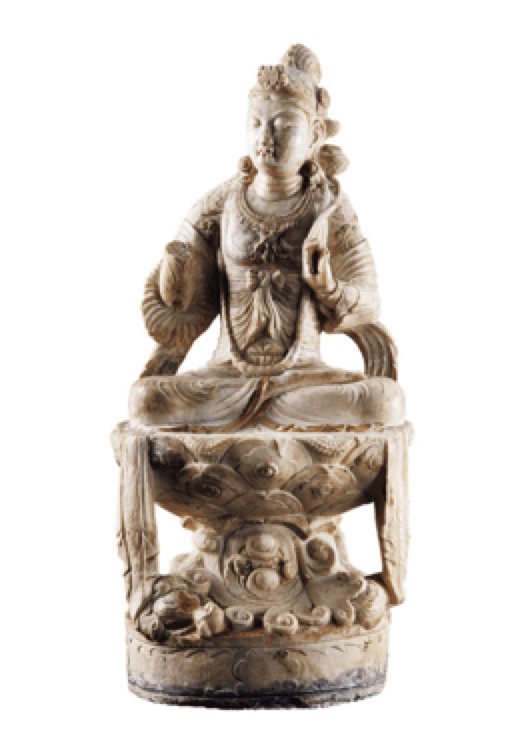
Excavated from Anguosi Temple Site, Xi’an
Beilin Museum, Xi’an, China
China, Tang dynasty, 8th century
Within the broader theme of transculturalism, the show focuses on founder Kūkai, his own vision of Mikkyo, and items associated with him. Some years ago, art historian Cynthea Bogel published a highly detailed and thoughtful book on the subject Kukai encapsulated in his statement “With a single glance [at the representations of the mandala divinities] one becomes a Buddha” – which provides the name of the book (With a Single Glance: Buddhist Icons and Early Mikkyo Vision). Here, Kūkai gave preeminence to the function of images over text when it came to grasping the teachings of Mikkyo. He was explicitly referring to the use of mandalas which though a somewhat contested question among present-day scholars of Mikkyo art and ritual is largely understood to be the internalization of deities. The 9th century Takao Mandala (more accurately, mandalas) is a pair of paintings which express the “Two Worlds” of the cosmos as understood by Mikkyo adherents. They are said to have been made by Kūkai based on mandalas he had brought back with him from China, and are the oldest of the type in Japan. The depiction of the cosmos of deities is delicate, decorative, and fairly simple – strictly diagrammatic delineations in gold and silver on a dark background – and because of the paintings’ age, origin in Kūkai, and status they invited reverence and interest over the centuries and were rather frequently moved around, and also repaired several times at the behest of emperors. They are certainly worthy of close examination and appreciation. Other items owned (or believed to have been owned) by Kūkai include a set of ritual tools, an initiation record, and a letter to fellow priest Saicho with whom he had a difficult relationship because of conflicting views regarding the correct transmission of the esoteric teachings.
A good selection of genres will be on display: paintings, picture scrolls, statues, ritual implements, and texts. The exhibits include around 30 designated National Treasures – one of which is the oldest set of Five Wisdom Buddha statues in Japan – and 60 Important Cultural Properties.
Sat, Apr 13, 2024〜Sun, Jun 9, 2024
Special Exhibition
Celebrating the 1,250th Anniversary of Priest Kūkai’s Birth: KŪKAI The Worlds of Mandalas and the Transcultural Origins of Esoteric Buddhism
9:30 a.m. – 5:00 p.m.
(Last admission at 4:30 p.m.)
Closed on Mondays except Apr 29 (National Holiday) & May 6 (Substitute Holiday). Closed on May 7th.
Nara National Museum
East Wing and West Wing
50 Noborioji-cho, Nara
Admission
Adults: 2,000 yen
University/High School Students 1,500 yen
Admission free for junior high school students and younger
Talks & Events
All talks take place on Saturday afternoons from 1:30-3pm in the Lecture Hall of Nara National Museum. Admission is free but prior registration is required. Please see here for registration. All events are in Japanese.
April 27th (Saturday) 「空海マンダラの世界―宇宙へのいざない」Kukai and the World of Mandalas: an invitation to the universe
Matsunaga Junkei (Vice President of Koyasan University)
Tickets available April 1st (10am) – 15th (5pm)
May 18th(Saturday)「日本仏教史における空海と密教」Kukai and Mikkyo (Esoteric Buddhism) in the History of Buddhism in Japan
Saiki Ryoko (Director of the Artifacts Office, Curatorial Department, Nara National Museum)
Tickets available April 22nd (10am) – May 6th 5pm
25th May (Saturday) 「高雄曼茶羅ー弘法大師御筆の両界曼荼羅」The Takao Mandala: The Mandala of the Two Worlds Drawn by Kobo Daishi [Kukai]
Taniguchi Kosei, (Director, Planning Office, Curatorial Department, Nara National Museum)
April 30th 10am – May 13th 5pm
Special Event:
May 25th (Sunday) 1:30-3:30 (10 minutes per performance)
In one of the exhibition rooms at the museum, students of Shuchi-in University (an esoteric Buddhist university) will perform Shomyo, the melodic and rhythmic chanting of sutras.
 ART & RITUAL JAPAN